Track Contract Obligations in 30–90 Days for Legal, Compliance & Ops

Contract obligation tracking is the practice of identifying every duty a contract creates, then monitoring who owns it and whether it gets done on time. The single most important action is centralizing every executed contract in one repository and assigning a named owner to each obligation the moment the ink dries. Everything else, from alert cadences to AI extraction, builds on that foundation.
TL;DR:
Assign a designated owner and delegate to each obligation immediately after contract execution to prevent missed duties due to shared responsibility or assumptions.
Prioritize tracking obligations related to renewals, deliverables, payments, SLAs, and compliance reporting, especially those with strict notice windows and statutory significance.
Use a centralized, searchable repository with clause linking, structured metadata, and audit trails to ensure accurate extraction, version control, and easy compliance verification.
Incorporate a review layer with confidence scores for AI-extracted obligations and route low-confidence items to human review to improve accuracy.
Implement alerts based on specific notice windows and escalate automatically if owners do not acknowledge them, ensuring timely actions and reducing overdue obligations.
Key Takeaways for Contract Obligation Tracking
Getting obligation tracking right doesn't require a massive overhaul. It requires discipline around a handful of moves.
Centralize every executed contract in one searchable repository, not scattered folders.
Extract and normalize obligations at signature, not months later when a deadline is already close.
Assign a single named owner plus a backup delegate for every tracked duty.
Set notice-window alerts (not just expiry alerts) with clear escalation paths.
Track obligation completion rate as your primary KPI. It's an important signal that something may be slipping.
Teams that skip the owner-assignment step tend to rediscover missed obligations only when a counterparty flags a breach, which is the most expensive way to find out.
What Does Contract Obligation Tracking Actually Cover?
Obligation tracking is broader than renewal tracking. Renewal-only tracking watches one date. Full obligation tracking watches every duty a contract creates: deliverables, payments, notices, reporting, insurance, and performance standards, in addition to the renewal clock.
An obligation is a legal or contractual duty one party owes another, and tracking it means capturing enough structured information that someone can act on it before it's missed. At minimum, each tracked obligation needs these fields:
Description: what must happen, in plain language.
Owner and delegate: who is accountable, and who covers when they're out.
Due date and notice window: when it's due, and how far ahead you need to act.
Clause source: the exact section of the contract that creates the duty.
Status: open, in progress, completed, or overdue.
Evidence: the document or confirmation proving it was fulfilled.
This structure is also what connects obligation tracking to contract lifecycle management (CLM) more broadly, and to audit readiness. When a regulator or investor asks how you know a duty was met, "we have the email somewhere" isn't an answer. A clause reference and evidence file are.
Which Obligations Should You Track First?
Not every clause deserves the same monitoring intensity, but these categories consistently cause the most damage when they slip:
Renewals and notice periods. Track the notice window's start date, not just the renewal date. Missing the window is usually what causes an unwanted auto-renewal.
Deliverables and milestones. Record the due date alongside acceptance criteria, since a late delivery and a rejected delivery require different responses.
Payments and pricing adjustments. Note the trigger event (volume threshold, index change, anniversary date) and the reconciliation cadence, not just the payment date.
SLAs and service credits. Capture how often performance is measured and exactly how remedies get calculated and claimed.
Reporting duties and regulatory notices. Log the recurrence pattern and who receives each report, since these often carry statutory weight beyond the contract itself.
Insurance certificates and compliance documents. Track expiry per entity, since a single vendor with multiple certificates is a common blind spot.
Contracts referencing regulated data, such as healthcare information governed by HIPAA, typically carry recurring duties like security reporting and breach notification that need their own monitoring layer, separate from standard commercial terms.
Why a Centralized Repository Comes First
A single searchable repository is the foundation everything else depends on, because scattered contracts almost guarantee missed obligations. Version control matters here in a very literal sense: if three people have three copies of the same amended agreement, nobody actually knows which clause is current.
Full-text search cuts extraction time dramatically. Instead of opening twelve PDFs to find a payment trigger, you search the term once across the entire repository.
Before you adopt a repository or CLM system, require these capabilities:
Clause linking, so every obligation points back to its exact source text.
Structured metadata, so obligations can be filtered by type, owner, or date.
Permissions, so sensitive terms stay visible only to those who need them.
Audit trail, so every edit, approval, and status change is logged with a timestamp.
How Reliable Is AI at Finding Obligations?
AI extraction is genuinely strong at surfacing dates, renewal clauses, and recurring obligation patterns across large volumes of contracts. It's less reliable on ambiguous language, nested exceptions, or obligations that only trigger under specific conditions buried three clauses away. That gap is exactly why false positives happen. AI might flag a termination clause as an obligation when it's actually a right, not a duty.
The fix is a review layer, not blind trust. Good extraction tools attach a confidence score to each flagged obligation, link it directly to the source clause, and route anything below a threshold to a human for confirmation or correction.
Require a confidence score and clause link on every AI-extracted obligation.
Route low-confidence extractions to human review before they enter the tracker.
Capture the clause reference and require evidence at closure, not just a status change.
Pro Tip: Run a 90-day audit on your AI-extracted obligations against the source contracts. If accuracy holds above your comfort threshold, expand the AI's scope; if it doesn't, tighten the human review gate before adding volume.
How Do You Set Up Alerts and Renewal Windows?
Alert design is where most tracking programs quietly fail, usually because they track the expiry date and nothing else.
Separate the notice window from the expiry date. The notice window is the action deadline. The expiry is just when the contract ends if nobody acts.
Set cadences that match the obligation type. Renewals typically warrant alerts at 90, 60, 30, and 7 days out. Certificates and insurance often work on a tighter 60/30/14 day cadence. Deliverables need lead time matched to how long the actual work takes.
Build escalation into the rule, not into someone's memory. If the owner hasn't acknowledged an alert within a set window, it should automatically escalate to the delegate, then to a manager, through email and a dashboard flag at minimum.
How Do You Assign and Maintain Ownership?
Every obligation needs exactly one named owner, even when a team collectively handles the work. Team-level ownership without an individual name attached is how obligations fall through the cracks. Nobody assumes it's their job, so nobody does it.
Name one accountable owner and one delegate for every tracked obligation, not a distribution list.
Build an owner-change checklist for role transitions: reassign obligations before someone's last day, not after.
Reconfirm ownership on a set schedule (quarterly works for most portfolios) as part of routine governance, not as a crisis response.
What Should a Compliance Dashboard Actually Show?
A dashboard earns its place only if it drives action, not just admiration. Four metrics matter most:
Obligation completion rate, your primary health signal.
Missed-deadline rate, which shows where the process itself is breaking down.
On-time renewal rate, which reflects the accuracy of your alert cadences.
Mean time-to-remediate, which shows how fast issues get closed once flagged.
Slice the same dashboard by counterparty, obligation type, business unit, and overdue severity to spot concentration risk before it becomes a pattern. A single counterparty accounting for a disproportionate share of missed deadlines is worth a direct conversation, not just a red flag on a screen. During audits or investor diligence, these same dashboard views double as evidence that your compliance program is active rather than aspirational.
What Does the Obligation Tracking Workflow Look Like Step by Step?
The workflow runs the same whether you're managing ten contracts or ten thousand:
Centralize. Upload the executed agreement and capture core metadata (parties, effective date, term).
Extract and normalize. Pull every obligation, standardize the fields, and link each one back to its clause.
Assign and schedule. Name an owner and delegate, set the due date, and configure the alert cadence.
Monitor and close. Track status, attach evidence at completion, and escalate anything overdue.
Reconcile. Audit the register periodically and adjust the process based on what your KPIs reveal.
Each stage has a clear owner and output:
Centralize — owner: contract admin / legal ops. Output: repository entry with metadata.
Extract and normalize — owner: legal ops (AI-assisted). Output: structured obligation register.
Assign and schedule — owner: the obligation owner. Output: alert cadence configured.
Monitor and close — owner: obligation owner + delegate. Output: evidence file, closed status.
Reconcile — owner: compliance / legal ops lead. Output: updated KPIs, process fixes.
Why Do Spreadsheets and Email Threads Fail at This?
Spreadsheets fail in four predictable ways: version conflicts when multiple people edit copies, no enforceable ownership since a cell isn't accountable to anyone, missed notice windows because static rows don't send alerts, and audit gaps when nobody can prove who did what and when.
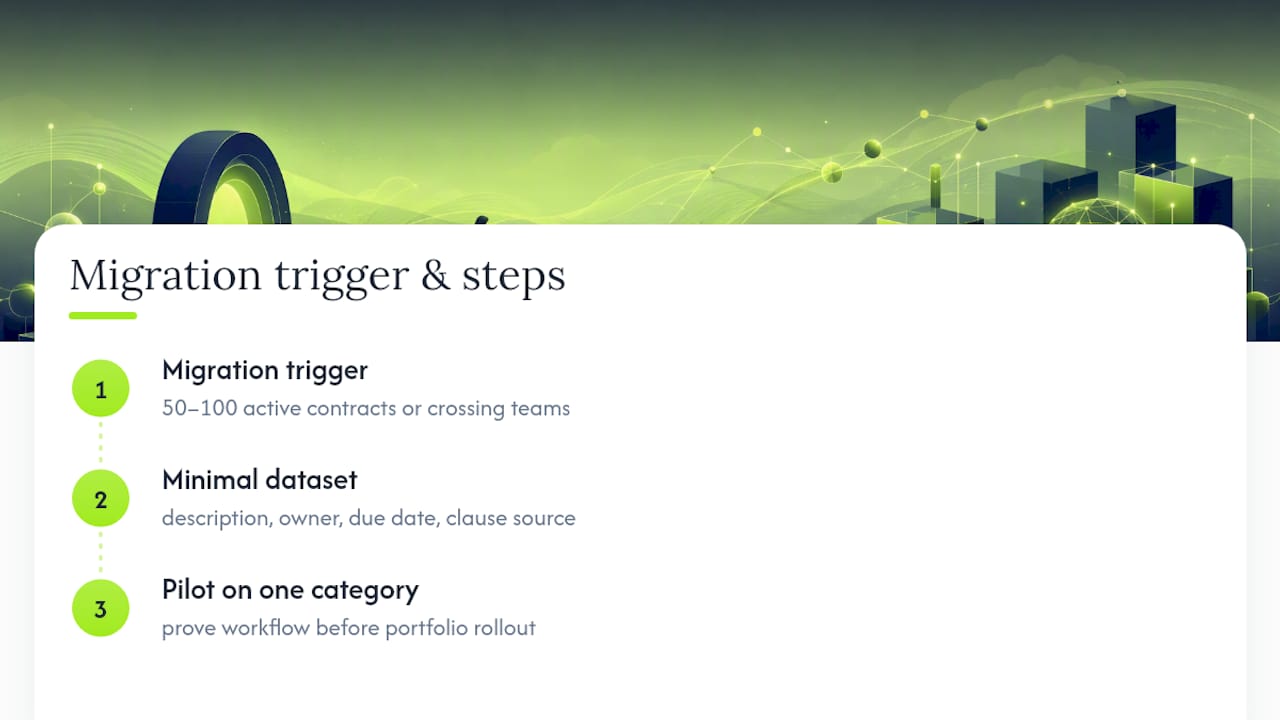
The scale trigger for migration is usually somewhere between 50 and 100 active contracts, or the moment obligations start crossing team lines regularly. Before switching tools, build a minimal dataset (obligation description, owner, due date, clause source) and pilot it on one contract category to prove the workflow before rolling it out portfolio-wide.
How Do Platforms Like Dilicheck Operationalize This Program?
Every element covered above maps directly to software capability: a centralized repository, AI extraction with human review, a named-owner model, configurable alerts, and dashboard reporting. Dilicheck builds these into one platform rather than stitching together a document store, a spreadsheet, and a calendar reminder system.
Centralized contract and compliance repository with full-text search and audit trail.
AI-assisted extraction paired with human review, so obligations don't go live unverified.
Assignment of an owner and delegate built into each tracked obligation.
Configurable alert cadences and escalation paths by obligation type.
Evidence retention tied directly to closed obligations, supporting audit and investor readiness.
For portfolio companies preparing for diligence or ongoing compliance reviews, this kind of structured record turns a scramble into a routine export. Documented case studies and customer outcomes will illustrate this in more detail as they become available.
What's the Real Gap Between Tracking on Paper and Tracking in Practice?
Most obligation tracking failures aren't caused by missing tools. They're caused by skipping the owner-assignment step because it feels like a formality at signature time, when the deal is done and everyone wants to move on. That's precisely the moment obligations get lost, because nobody circles back to assign accountability once the excitement fades.
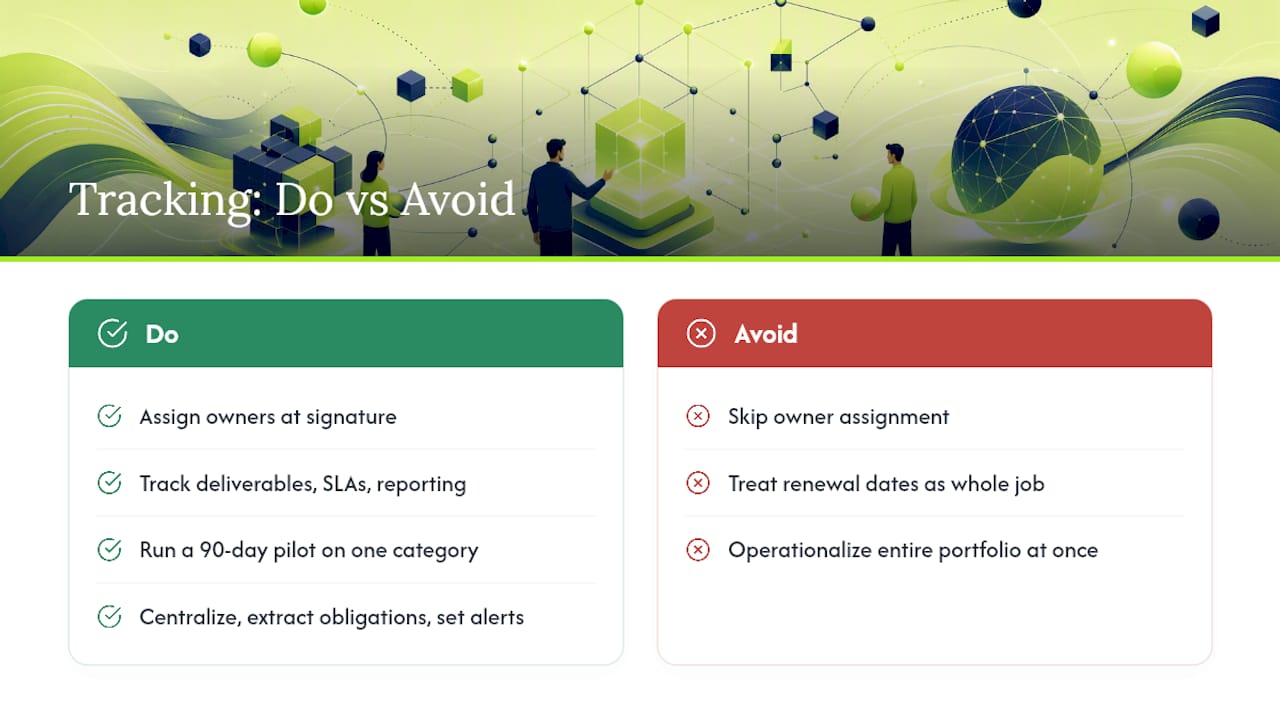
The other recurring mistake is treating renewal dates as the whole job. Renewal-only tracking ignores deliverables, SLAs, and reporting duties that cause far more disputes than a missed auto-renewal ever does.
If you're starting from scratch, run a 90-day pilot on one contract category, say, your top twenty vendor agreements. Centralize them, extract obligations, assign owners, and set alerts. Success looks like a completion rate above your baseline and zero missed notice windows by day 90. Expand from there once the workflow proves itself, rather than trying to operationalize your entire contract portfolio on day one.
— Matias Toye
Ready to Put This Into Practice?
Everything in this guide, centralized contracts, extracted obligations, named owners, alert cadences, and dashboard reporting, is easier to sustain when it lives in one platform instead of four disconnected tools. A dedicated platform can replace the spreadsheet-and-email approach with a single system that extracts obligations automatically, flags them for review, and keeps your compliance evidence audit-ready year-round.
If you're managing contracts across a portfolio or preparing for an investor review, start by mapping your own gaps against a SaaS due diligence readiness checklist. Then see how Dilicheck handles the extraction, ownership, and monitoring work you'd otherwise be doing by hand.
Sources
For grounding in the legal fundamentals, Cornell's Legal Information Institute defines what an obligation is in contract law. For sector-specific duties, the HHS HIPAA overview explains recurring compliance obligations in regulated data contracts.
Ready to automate your due diligence?
Get a free healthcheck of your company's audit readiness. No credit card required.
Related articles
Cut Cycle Time in Legal Ops: 5 Pilot Contract Management Best Practices
The highest-impact contract management best practices come down to five moves: centralize every agreement in one searchable repository, standardize templates and clause libraries, assign clear RACI ownership, automate intake and approval routing, and track KPIs like cycle time and renewal accuracy. This guide breaks the work into a prioritized list, a phased rollout, and the metrics that prove it's working.
Avoid the 72 Hour Breach Trap in Data Processing Agreements
A practical guide to data processing agreements: what GDPR Article 28 requires, how to structure and negotiate a DPA, where compliance programs actually break down after signing, and the Article 27 representative requirement that catches non-EU/UK companies off guard.
Roll Out Private Equity Legal Operations and Cut DDQ Time
Legal operations creates value across the whole private equity ownership lifecycle — acquisition, first 100 days, hold period, bolt-ons and exit — not just at the diligence stage. This guide covers continuous legal readiness, the people-process-technology-accountability framework, portfolio legal health baselines with permissioned reporting, contract intelligence beyond renewal dates, and legal resource management beyond invoice review.